

Spotlight on: Mariela, KindyROO Cyprus

This month we sat down with Mariela, our KindyROO Cyprus class teacher and franchisee. Dedicated to the KindyROO philosophy and a wonderful mum to her 2 year old son, Mariela is navigating motherhood and managing a successful, growing business that she’s passionate about – both physically and mentally demanding, full time jobs!
Based out of 10, Myrtiotissis, Germasogeia 4041, Limassol, Mariela has been running KindyROO classes for just over 6 months and has brought her warmth and knowledge to many new parents in Cyprus. We interviewed Mariela to get a taste of her life in Cyprus!
So, Mariela, First off, what’s it like being a mum in Limassol?
As with everything in life being a mum in Limassol, Cyprus has it’s good and it’s not as good sides! I love the weather, the island is famous for its abundant sunshine and the summer which lasts 6 months long. This really suits me and my family because we don’t like the cold, rainy weather. The only downside to this is that July and August tend to be extremely hot, so sometimes we need to spend more time inside than what I would prefer.
I get a little frustrated that I need to use our car to get to most places. Sometimes I just want to take my son in his pushchair and go to the nearest park by foot and enjoy the nature but I’ve tried it a couple of times, and it wasn’t the best idea! There wasn’t really enough pavements to easily do this with a stroller.
Apart from these little inconveniences, living in Limassol, which is on the beach, is incredible! Mums like me get the chance to enjoy the sand and sea and share this lovely, special place with our little ones. Cyprus life really is a lovely life- especially now that KindyROO is here!

Outside of KindyROO, what are some of your passions?
I have always been a person who loves to learn. I like learning new languages (I’m fluent in English, Greek, Bulgarian and almost fluent in Russian!), obtaining new skills all the time and broadening my horizons. KindyROO’s extensive ongoing training satisfies my thirst for new knowledge and information and ensures I provide parents with as much information about their child’s development as possible.
How did you become passionate in the field of early childhood development?
When I was pregnant with my son I started learning more about early childhood development, as most mums do. But my passion for development grew even bigger after the difficult birth of my son.
I had a very difficult delivery and the first couple of months of my son’s life were very hard to say the least. I don’t want to go into too many details, but my son spent almost a month in an incubator and doctors were worried that he might have sustained damage to his brain.
During this time, I realized that I needed to do my best to help him have a better life and I knew how to do it. Once we got home I started incorporating KindyROO activities in our day to day life. I started singing, dancing, massaging and playing with my son and the results were astonishing! Now, he is a happy, healthy and outgoing boy, who loves music and continues to meet all his neurological milestones on time.
Having been so close to losing my child – I know how important it is to appreciate every second you get to spend with them. Children are a precious gift and we need to make sure we provide them with what they need the most – our time and attention!
What do you enjoy most about KindyROO?
I have always liked teaching and I love singing and dancing. What is more, I have always been very good at seeing the potential and talent in others and helping them to develop it, so teaching KindyROO classes came quite naturally to me and I find it really fun!
I would have to say that the thing I enjoy most is being around mums, kids and babies! I love seeing mums and dads spending quality time with their little ones and seeing the happiness and enthusiasm in their eyes as they come to class, it brings me so much joy!
I love the fact that I have the absolute privilege of being a child’s second teacher (after their parents) and I make sure to build a secure and loving relationship between me and my young “students”. I am so proud to see them progress day by day, getting stronger, calmer, becoming more social and outgoing and learning to share and take turns. It is heartwarming to see a shy toddler transform into a confident child in a couple of months!
The program is wonderful – its diversity amazes me every single day. I love it!
“The most amazing class for babies/toddlers/children... and moms!! A wonderful, patient and loving instructor, very helpful overall programme for a child's development.” - Marina, KindyROO Limassol Parent
How you manage the crazy world of motherhood and running a successful business?
To be completely honest, the first couple of months were not easy. As every mum would know, I have had to learn how to balance my family life and my passion (I would not call it work).
People say I am a young entrepreneur – and that sounds great, but it is way more challenging then people can even imagine! In saying that, it’s been a very rewarding journey.
I have had to learn how to better structure my day so everything can go smoothly (although as most mums would know, that’s not always the case!). I have become more organized and started prioritizing my tasks. Also my loving husband, who is my biggest fan, has been a great support, which has meant everything to me.
I have found many advantages and positives of being a “mumtrepreneur”. The advantage of my business is that I’m at the same stage in life as my clients – I can empathise with them as I’m going through much of the same struggles as they are. This has made my interactions with them truly meaningful as we are able to share about our similar experiences and support each other.
What’s the best piece of parenting advice you’ve received?
It’s a bit of a cliché but one of the best pieces of advice I have been given is to follow my intuition and to listen to my child.
Motherhood is a blessing, but at times it can get really tough. Breastfeeding, weaning to solids, the tantrums and meltdowns, these are all parts of the colourful journey called parenthood. Parenthood is a journey and not a race. Staying present is key.
If I can give parents one honest piece of advice it would be this: treat your kids with respect and believe in their potential.
To find out more about Mariela’s classes, keep up with her on facebook or book a class here:
“Spotlight on” is a series in which we’ll be giving you an insight into the life of our KindyROO Europe Franchisees. Interested in franchising? Contact us here


KindyROO Presents At For Babies Expo Prague
“The brain has developed more complex connections because movement stimulates growth and connectivity of neuronal pathways” (Melillo & Leisman, 2004).
Saturday, October 18th, saw the 10th annual ‘For Babies’ Expo event at the PVA exhibition Centre, Prague. Jana Uher from our KindyROO Prague branch was able to present the lecture: “Why the First 1000 days are the most important in a child’s life”.
Along with the “For Babies” expo, the “For Toys” and “For Games” Expos also took place. This 4 day event saw a great turn out with hundreds of parents and their kids interested in seeing the newest products, services and trends in the world of products for babies, childrens’ furniture, fashion and hygiene.
KindyROO’s Jana was given the opportunity to speak to many new and expecting parents about early childhood development and introduced them to the concepts learnt within the KindyROO classroom.
Some highlights from Jana’s presentation include:
- Early brain development is the key to lifelong academic, emotional and social wellbeing
- We’re born with billions of brain cells and as we experience the word, these brain cells begin to interact and form brain connections
- Movement is the key to learning, but not just any movement: it needs to be appropriate for each stage of development, make use of natural movement patterns and build on previous levels of development
The biggest takeaway from Jana’s presentation was that you as a parent can and should be involved in your child’s development from day 1. KindyROO classes guide parents through the early years, helping teach parents about their baby’s development from birth. KindyROO classes specialise in age appropriate exercises, games, dances, massages which help children to meet developmental milestones and be ready to crawl, walk, socialise and prepare them for school (when the time comes!).

School readiness: Is my child ready for school? A checklist
KindyROO kids are excelling academically, emotionally, in leadership roles and on the sporting field.
Lyn Jarvis
Every parent wants to give their child the best start to school, but we often get caught up with rote learning of numbers, colours, letters and shapes, hoping this will give our child a step-up on the way to formal education. For school readiness however, it is more valuable, to know that your child’s brain and body are ready to learn. At KindyROO we hold specialist School Readiness classes to ensure your child will have the best possible beginning to school life.
Both physically and neurologically, our bodies and brains need to be ready to learn. For example, writing involves a lot more than holding a pencil and copying a letter. To be ready to write easily children need to have the following:
- Good tactile and body awareness so they can control their fingers automatically.
- Posture and balance developed to the extent that they can sit still easily and concentrate on their work.
- Auditory perception and processing skills so they understand the instructions given by their teacher.
- The ability to move their eyes smoothly from what they are copying to what they are writing.
- The ability to ‘picture’ the letters they are writing in their mind (visualisation).
- The fine motor skills to manipulate the paper and pencil.
- The hand-eye coordination to write correctly what their eyes have seen.
- Temporal awareness; an internal understanding of time, to be able to do the allotted task in the time allocated.
When all of this is in place, our children can easily take on the task of writing.
However, if one or more of these factors are not fully developed, then a child may potentially struggle with the writing tasks at school. This short video on body awareness explains this further.
Lots of movement experiences give us an internal awareness of both sides of the body. This allows children to move all their body parts independently of each other, crucial to managing in a classroom environment. By school entry, children should have a preferred hand firmly establishedand be able to cross their midlines. Parents may not be aware that young children have a midline – an ‘invisible line’ down the middle of their bodies, from their heads to their toes. Children need to be able to cross over this midline easily with arms, legs and eyes without twisting their bodies or heads. This ability to cross the midline repeatedly and without difficulty indicates that children are lateralised and are ready for higher-order cognitive thinking. This is crucial for success at school and sport.
Children who are not fully lateralised at school risk encountering learning difficulties. If their eyes do not cross smoothly across the midline, they cannot easily follow words across a page without losing their place, leading to reading difficulties. Writing will also be problematic, as their preferred hand will not cross fluently from one side of their body to the other. This will result in children twisting their paper and sitting awkwardly to avoid crossing the midline, or instead swapping the pencil from one hand to the other as they reach the middle of the page.

Not being lateralised will also affect children’s physical prowess and sporting ability. Cross pattern movements – movements that involve crossing the midline and the two sides of the body working well both individually and in unison – will be jerky and uncoordinated and balls skills a nightmare.
At KindyROO, every activity in our School Readiness classes is carefully planned to ensure children have the best skills in place to start school. We practice auditory processing skills, visual skills, word recognition and word games, finger and body awareness, motor planning, laterality, temporal awareness, sequencing and directionality, gross and fine motor activities, cross pattern movements, balance and posture – all while we are having fun dancing, singing, spinning, swinging, tumbling, jumping, balancing and laughing!

Here is a brief checklist of skills required for school readiness
Personal/Social Skills
- Adapts to unfamiliar settings and new experiences.
- Can finish a task and tidy up afterwards.
- Plays cooperatively with other children (shares and takes turns).
- Can separate from parents.
- Can cope with criticism and some frustration without becoming upset.
- Is responsible for own belongings.
- Can sit still and listen.
- Read more: Why KindyROO kids excel socially and in leadership roles
Language
- Talks to other people about familiar objects and events.
- Can speak in full sentences, which are grammatically correct.
- Has a fairly wide vocabulary and can pronounce words clearly.
- Answers and asks simple questions.
- Makes needs known.
- Follows a sequence of three instructions (minimum): e.g. put your pencil beside your book, stand up and wait until I tell you to line up for recess.
- Uses books for enjoyment and for looking at pictures.
- Can repeat several nursery rhymes and tell stories.
- Can make up a story from looking at pictures.
- Can identify the beginning, middle and end of a simple story.
- Joins in singing familiar songs.
- Recognises own name when written and understands that written symbols have meaning.
- Can distinguish between sounds that are nearly the same.
- Read more: Why KindyROO kids excel at the three R’s – wRiting, Reading, aRithmetic (maths)
Gross and Fine Motor Skills
- Has a preferred hand for skilled tasks.
- Can jump with two feet together; forwards, backwards and sideways.
- Can balance on one foot and count to ten.
- Can hop on each foot and can skip along.
- Has good body control in running with a cross-pattern action.
- Is able to march automatically with a cross-pattern action and therefore able to move and think at the same time. This is necessary to carry out verbal instructions while moving.
- Can walk up and down stairs using alternate feet, without holding on.
- Can throw, catch and kick a ball with a cross pattern action.
- Can climb confidently on outdoor equipment.
- Is aware of all fingers and can use them independently.
- Can follow a figure eight pattern with eyes teamed (without moving head).
- Read more: Why KindyROO kids excel at sport
Cognitive Skills
- Has an internal awareness of two sides of the body and be able to move them independently of each other.
- Can draw a person with head, legs, trunk, arms and fingers. This needs to come from the child’s internal awareness of the body, not be taught by an adult.
- Can draw a recognisable house or such-like spontaneously.
- Can name drawings before doing them.
- Ability to copy a cross, square, V H T O.
- Can name colours, can count items 1-20, can name shapes.
- Can identify which picture is different in a pattern.
- Understands direction concepts of up, down, across, behind, forwards, backwards, etc.
It is important to realise that children without the above skills will still learn. However, children who cannot do a number of the above tasks at school entry are at risk for learning difficulties. Knowing colours and numbers is not enough. For school readiness, children need to be able to think and move at the same time by ensuring they have good balance and coordination. They need to have practiced visual and listening skills, be able to sit still and concentrate, and enjoy facing new challenges. For our children to start school as confident, capable learners they need to have both their bodies and their brains ready to learn.

Lyn Jarvis is a qualified KindyROO Early Childhood Neuro Physiological Development Consultant, and GymbaROO/KindyROO teacher trainer.

KindyROO Open Day in Limassol, Cyprus
Hi there informed, involved and passionate parents!
We have excellent news: KindyROO arrives in Cyprus!
We invite you to open day on Saturday 2nd of February at Kristen’s Pilates Studio, Limassol. ( See Location here )

“I am Mariela and as mother and educator I was impressed with KindyROO and had to bring the methodology to our country! I believe that every child deserves best start in life and that every parent deserves support and access to knowledge and expert tips and ideas.
I am committed to work with parents and children to ensure that through fun activities and play neurological milestones are met and natural development stimulated.”
Cannot wait to meet everyone of you. Join me for a dose of weekly developmental fun! 🙂

Depending on your child’s age please come to one of the three demo lessons:
11:00 – 12:00 – Wombats ( crawling to walking )
12:15 – 13:15 – Platypus ( 6 weeks to crawling )
15:00 – 16:00 – Penguins and Koalas ( walking to 2 years old )
Come and join us to learn more about Australia’s number one fun sensory motor program for children from six weeks through to the age of five years.
KindyROO lays the foundations for:
better living by enhancing physical, social and emotional skills and for better learning by helping concentration and prepares the child for reading, writing and maths.
Looking forward to seeing you soon!
♥ Your little ones will love it and so will you! ♥
 +357 96 659877

 KindyROO Cyprus
 Enrol here

Activities with dad!
We all know how important play is for learning – some refer to play as ‘children’s work’. If children have lots of opportunities for playing, then their opportunities for learning are improved – both at the time they are playing, and later in school. Dads bring an important mix to the type of games children play – and this helps ready children for the challenges of the classroom and school yard.

Playtime with both parents is important for the development of pre-school aged children. You just need to watch how mums and dads play differently with their children to notice the different kinds of play opportunities that parents provide. It should come as no surprise that dads tend to be more vigorous – they are more inclined to encourage children to play out-of-doors activities that involve a bit of rough and tumble. Research lead by Dr Richard Fletcher of The University of Newcastle has found that “playing with dad can boost a child’s vocabulary and ‘rough and tumble’ play is an excellent way for children to learn how to manage strong emotions, such as anger.” Dr Fletcher’s research also shows that fathers’ high-quality ‘rough and tumble’ play is linked to fewer behavioural problems in pre-schoolers.
“Pre-school children are developing their language and self-control at a terrific rate and early interaction with both of their parents will help develop these skills before they walk through the school gates,” Dr Fletcher said. “In the classroom children need to learn how to wait their turn, explain themselves coherently and know how to co-operate with other children. Playtime with mum and dad is essential to learning social norms and how to behave in a range of situations.”
Here are some great ideas from the Fathers for School Readiness resources:
Balancing with dad:
This activity has three parts, so depending on how tall your child is or how well they can balance; you can decide which types of balancing activities you’d like to try.
- Dad and child facing each other, holding onto each other’s right hand. Keeping both feet on the ground with toes facing forwards, both players will lean back as far as they can until they’re nearly falling over. Finding the balance with the two players being such different sizes makes this a difficult game! If you fall over, just hop back up and keep trying. You can also alternate to holding each other’s left hand.
- Facing apart and standing sideways to each other, with your right hand, hold onto your child’s left hand and try to balance each other out like the first exercise. Try alternate hands as well, facing apart the opposite direction. Make a show of how strong they are!
- The alternate version of No. 2. is where you try to pull your child over the line as they try not to be pulled over
What is my child learning?
This activity will help your child develop spatial awareness and problem solving skills. It also stimulates the balance organs in the inner ear, the brain stem and the cerebellum, and enables our brain to organise itself so that the body can appropriately responds to gravity. This affects our posture, balance, vision and coordination – all essential skills for sitting still in a classroom or controlling the body in active games at school. It also assists in speech and literacy. Encourage your child to try out new words or practice phrases they’ve heard before when they tell you how to stay standing without falling. This is a good way to practice communication and vocabulary while doing something fun!

Increasing the degree of challenge:
- Let your child lead the activity and practice giving instructions.
- Ask questions about their actions… they must be feeling pretty powerful if someone their size can balance out someone your size!
- Give suggestions on how to help if your child is becoming unbalanced. What tricks do you use when you’re about to fall over?
- Have fun with the activity… falling over is part of learning!
- Other balancing games include: Walking in a straight line and avoiding obstacles, playing musical statues (dance around until the music stops, then you have to freeze! Use slow and fast music and alternate directions) or balancing on one leg at a time.
So, have a great time with the kids dad, they will love you for it!

Why KindyROO kids excel at sport
Dr Jane Williams
KindyROO graduates as rising sports stars
Sporting prowess is perhaps the easiest area of development to understand in regard to its link to KindyROO, after all, KindyROO is a movement-based program and one would expect that if you practice motor skills on a regular basis, then you will develop the skills needed to become a talented sports person. We are presently documenting hundreds of stories involving KindyROO graduates doing exactly that and excelling in their chosen sporting fields. Here is one such example. A FIFA qualified soccer coach is a strong advocate of the KindyROO program. He explains: “I see many young soccer players hopeful that they will be scouted to play at league level. At 15 years of age, when trialling for my elite training squad, I can pick out KindyROO graduates as soon as they run onto the field. Of the seven graduates from this squad that have been selected to play European league, six are KindyROO kids.” He explains what he sees in these teenagers that makes them stand out.
- KindyROO kids are so well lateralised that they have excellent control of both left and right feet. They are able to automatically and smoothly coordinate movement and this gives them the ability to manipulate the ball expertly while moving in any direction.
- KindyROO kids have quick reflexes, enabling them to respond to rapidly changing circumstances and conditions on the field.
- KindyROO kids have hand-eye coordination that stands out. This gives them the leading edge on other players, as they are able to manipulate the ball with great skill.
- KindyROO kids have excellent spatial awareness – this means they know exactly where they are on the field at any time, exactly how far, in what direction and with what power they need to kick a ball, and how quickly they can move to a new location on the field.
- KindyROO kids can visualise – essential for accurate execution of passing/kicking/catching a ball all whilst on the move.
- KindyROO kids follow instructions and do not need them repeated.
- KindyROO kids are more attentive.
- KindyROO kids show more initiative.
- KindyROO kids demonstrate leadership skills – a key component for a successful soccer career and which matters most for team sporting careers.
This coach so strongly believes that KindyROO is the essential ingredient for sporting success; he suggests that if we want great future Socceroo or Matilda Olympic teams, then we need to make sure everyone does KindyROO from babyhood!
Why are KindyROO graduates so successful on the sporting field?
There is a very good reason why the GymbaROO journey begins at six weeks and continues until your child is five years old. It is during these earliest years that the foundational neurological processes essential for sporting prowess are ‘wired up’. This is a step-by-step process. Starting from automatic responses, babies gradually learn to control a movement skill, practice it, refine it and then move on to learning the next level of skill. The activities offered at GymbaROO help babies and children gain the important sensory and motor stimulation required for each step on this ‘ladder of learning’. Skipping or breezing over any of these ‘steps’ will make achieving a high level of proficiency and coordination near impossible.

One of the skills the FIFA coach refers to is a brain process called ‘laterality’. Laterality refers to the ability of the brain to control either side of the body separately, in unison or in opposition. It enables a child to coordinate both sides of the body at the same time, while each side performs a different task. For example, when kicking a ball, one leg is kicking while the other maintains balance. Good bilateral integration, or coordination, is an indicator that both sides of the brain are communicating effectively and sharing information so that the body can operate in a smooth, coordinated and timely manner.

The foundations of laterality are built gradually over the first three years of life, however the skill is not properly refined until three to five years. A good indication that a child has developed laterality is that they can cross the midline of their body. Crossing the midline refers to the ability to spontaneously cross over the midline of the body during movement tasks – moving one hand, foot or eye into the space of the other hand, foot or eye without having to turn the body. Children who are have excellent laterality skills will also have excellent ball control skills, have quick reflexes and ‘stand out’ hand-eye coordination.

Visualisation is also a critical component of any team sport. It enables a player to be able to ‘see in their mind’s eye’ how the game is playing out, what the potential future moves are likely to be and how to respond BEFORE the moves are executed. At KindyROO we start visualisation activities from baby classes. It takes years to be highly competent at visualisation and practice, practice, practice is the key.

Of course, developing any of the skills that coach Tony Samaras talks about does not happen overnight. Repetition is important for them all, that’s why we suggest you and your child enjoy some key GymbaROO activities every day at home. If you come along regularly to class and repeat activities at home, then over five years you will see your child gradually but surely develop the skills essential for sporting success and prowess.
Dr Jane Williams (PhD, BMgt, RN(Paeds)) is the Research and Education General Manager for KindyROO. She is one of Australia’s leading experts on baby and child development. More on Dr Williams here.

Primitive Reflexes – Why parents need to know about them
Dr Jane Williams and Bindy Cummings
Primitive reflexes have been in the news lately as it becomes more widely understood that if babies and young children do not have the movement opportunities and practice to learn to fully control the reflexes, the ‘retained reflexes’ can interfere with later learning and development.
“What is later seen in the classroom as bad behaviour, lack of impulse control, poor social skills and difficulty in learning, despite good intelligence, may, in some cases, be symptoms [of retained reflexes and hence] an underdeveloped central nervous system.”¹
Babies are all born with a specific set of primitive reflexes. These reflexes are vital to the survival of newborn babies but also, and significantly, primitive reflexes are responsible for getting babies moving and are of major importance to your babies’ brain development and the development of their balance, muscle tone, head control, vision and even the development of how well they use their hands and feet.

These early movement reflexes are designed to have a limited life span – they help babies learn how to move, however, to be able to move freely and easily babies need to learn to gain control of these reflexes. Once controlled, your baby can then move smoothly to the next level of movement and brain development.
If not fully controlled, children could end up being partially stuck in a lower stage of brain development and this will affect, to some degree, all their future learning.
A large portion of healthy, intelligent children who end up with learning difficulties at school have retained reflexes. These children have not yet managed to bring the primitive reflexes under full control.
Fortunately, the way babies learn to control these primitive reflexes, occurs as a result of going through the normal, natural sequence of developmental movements – that is, through tummy time, head control, learning how to roll, crawl on their tummies, creep on hands and knees, climb and then walk.
It is both fascinating and marvelous how it all happens. Each movement helps babies learn to control one or more of the primitive reflexes.
Our free Primitive Reflexes video explains everything you need to know about these important reflexes; how they play a part in your baby’s development and what you can do to ensure your baby has the opportunities to fully control these reflexes.
Enjoy this excerpt. Find the full Baby Reflexes video here.
Resources: 1. http://www.irishtimes.com/life-and-style/health-family/parenting/how-creeping-and-crawling-influence-children-s-first-step-in-education-1.2225493#.VXRGbT_qsnA.facebook
Dr Jane Williams (PhD, BMgt, RN(Paeds)) is the Research and Education General Manager for GymbaROO and KindyROO. She is one of Australia’s leading experts on baby and child development. More on Dr Williams here.
Bindy Cummings (B.Ed hons) is a teacher, GymbaROO early childhood neurodevelopmental consultant, early childhood development lecturer, INPP consultant and iLS consultant. She is the Editor of GymbaROO’s First Steps magazine. More on Bindy Cummings here.

Why KindyROO kids excel socially and in leadership roles
As well as laying down the foundations for academic, emotional and sporting success, the KindyROO program also sets children up for excellence in social and emotional skills. KindyROO graduates are generally socially adept and emotionally mature, which makes them great team players, great leaders and great classmates, and many are now leaders in schools and communities.
To do well at school socially and emotionally, and to become future leaders, children need to be able to achieve the following skills from their earliest days in the school classroom:
Social skills:
- Be able to trust and relate to other adults.
- Be able to take directions from other adults.
- Be able to go to preschool without too many tears.
- Be able to mix happily with other children at preschool.
- Be able to take turns and share.
- Have begun to have friends over to play.
- Have special friends and can talk about them in conversation.
Emotional skills:
- Be able to separate from parent easily.
- Have confidence in own abilities.
- Be able to participate in activities by self.
- Be able to participate in group activities.
- Be able to exercise some self-control.
- Be able to take responsibilities for getting started, packing up.
- Be aware of other children’s needs.
- Be able to concentrate for short periods up to ten minutes.
How the KindyROO program encourages the development of the above skill set
At KindyROO children are given the opportunity to develop these skills throughout the entire program of activities. While our key focus is on movement – as it is through movement that we create and build key neural pathways essential to learning – our movement activities are intertwined closely with opportunities that also stimulate emotional and social learning.
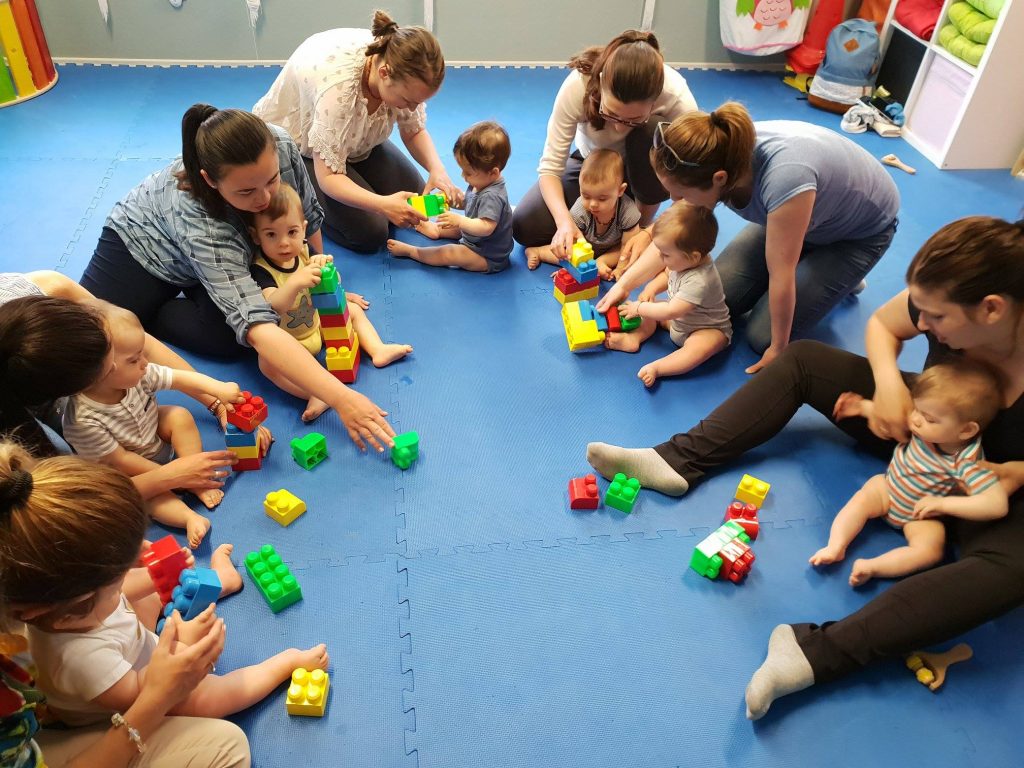
Even from as young as mobile babies, children in a KindyROO class learn to take turns, cooperate with others, share equipment, work out how to navigate around others when moving, and learn to make eye contact with other children and adults other than immediate family. Babies and toddlers learn to follow instructions on request from someone other than their parents; they build trust in someone other than their parents as they use the KindyROO equipment assisted by their KindyROO teacher; they participate in group activities as they play with small equipment, learning to share and building awareness of the needs of others.
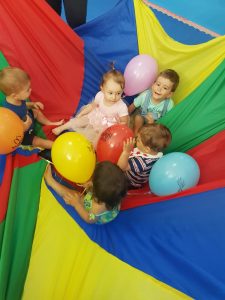
Taking turns while waiting to climb up a ladder, roll along a mat or be handed a piece of equipment helps young children learn to exercise self-control. Self-control is a key ‘school ready’ skill. Long-term research has shown that young children who have excellent emotional regulation in the form of self-control at four years of age learn more successfully at school and are less likely to be overweight.
Concentration is also a key ‘school-ready’ skill. Children who can concentrate for periods of ten minutes at a time when they start school are far more likely to be successful learners. They can follow a sequence of instructions, remember them and act on them correctly. Imagine if you arrived at school and a short concentration span enabled you only to remember the first instruction from the teacher, “sit down”, and not the remainder – “get out your blue work book and pencil and open to page 10.” Learning is enormously difficult as the child struggles to work out exactly what she or he needs to do. At KindyROO we deliberately include auditory sequencing training in class. For our one year olds, we ask them to follow a sequence of one or two instructions, for our two year olds, a sequence of two or three, and by the time a child is five years of age and ready for school, they should be able to follow a sequence of five to six instructions.
Incorporating movement into a sequence of instructions helps the brain develop the necessary pathways that enable a child to build on the sequence as it is learned. For example, one year olds: “Can you step into the hoop?” Two year olds: “Can you jump forward into the hoop and step out backward?” Three year olds: “Can you hop forward into the hoop, step sideways out of the hoop and then jump around the hoop? Four-five year olds: “Can you jump in the first hoop, hop into the second hoop, turn around and jump into the third hoop then do a somersault through the fourth hoop?”

Importantly, successful learners are much more likely to be happy, confident and to enjoy school, and this assists in both social and emotional maturity as it keeps stress levels to a minimum. Children who are stressed at school find controlling their emotions much harder because the stress hormone- cortisol – floods their brain and keeps them in a ‘flight or fright’ high alert state of mind. The anxiety that arises as a result of high stress distracts the mind from concentrating on the task at hand, so learning is compromised. Anxiety affects the maturation of the emotional areas of the brain and this impacts on the ability to socialise easily and to cope with the everyday challenges of school.

At KindyROO we provide lots of movement activities that help the brain to release the ‘feel good’ hormones – endorphins – that help children think clearly, concentrate, develop good self-esteem, confidence and emotional regulation skills that come with the success of learning new tasks and skills at each and every age and stage of development. Importantly KindyROO activities all occur in an environment where babies and small children feel safe as they are with their important family member or caregiver. Feeling ‘safe’ means the brain is stimulated by these feel good hormones to learn new tasks and to tackle new challenges without fear of failure or rejection. Continuing these activities at home on a daily basis is also an important part of the healthy development of social and emotional skills.

As a little example of developing leadership abilities we were delighted to hear that out of twenty-five babies who enrolled in the Maitland KindyROO centre in 2005, fourteen continued in the program until going to school. Of these fourteen, SEVEN became Primary School Captains in 2016.
KindyROO is about more than having a good time. It’s designed to ensure children have the very best possible beginning as they launch into their life at school and beyond, not just academically and physically, but also socially and emotionally.
Dr Jane Williams (PhD, BMgt, RN(Paeds)) is the Research and Education General Manager for KindyROO. She is one of Australia’s leading experts on baby and child development.

Why KindyROO kids excel at writing, reading and arithmetic
The KindyROO program is designed to ensure that babies and children go through the normal developmental sequence of movements and are given plenty of opportunity to practice, repeat and refine these movements within each stage of development. It is only through repeated movement experiences that the young brain grows and connects efficient and effective message pathways that optimise brain development and provide the foundations for more complex levels of learning such as reading, writing and mathematics.
Writing
The human body is genetically programmed to develop from the centre of the body – big muscles – to the outer parts of the body, dominated by the small muscles. Proficiency at any fine motor (small muscle) task, depends firstly on the development of the associated bigger muscles, (gross motor). Handwriting is one such fine motor skill. Learning to write actually begins in infancy. If the big muscles do not receive adequate stimulation and development, then there is a flow on effect to the small muscles in the hands and so writing, or any task requiring manual dexterity, can be affected.
Through tummy time, commando crawling and creeping our babies begin their journey towards being proficient hand-writers as they gain control over primitive reflexes, develop muscle tone and strength in the hands, arms, shoulders, neck and back – vital for later fine motor skill development.

As they grow, young children continue to develop their upper body strength as they push, pull, lift, carry, climb, hang and swing – working on both the gross motor component of handwriting and fine tuning manual dexterity skills. Holding, hanging and swinging correctly helps with the development of cortical grip which will help to ensure that the correct mature pencil grip will develop over time. This is one of the reasons you will find so many hanging and swinging opportunities throughout our KindyROO classes.
Becoming competent on the KindyROO overhead ladder (monkey bars) not only works on gross motor abilities and strengthening but also developing hand-eye coordination (the eyes will follow the hands when moving from rung to rung), motor planning (moving and thinking), timing, rhythm, posture, balance and laterality development.

While muscle development and upper body strengthening are vital components necessary for proficient handwriting, there are other areas of skill development that are also needed by our young hand-writers.
To be ready to write easily children need to have the following:
- Good tactile and body awareness so they can control their fingers automatically.
- Posture and balance developed to the extent that they can sit still easily and concentrate on their work.
- Auditory perception and processing skills so they understand the instructions given by their teacher.
- The ability to move their eyes smoothly from what they are copying to what they are writing.
- The ability to ‘picture’ the letters they are writing in their mind (visualisation).
- The fine motor skills to manipulate the paper and pencil.
- The hand-eye coordination to write correctly what their eyes have seen.
- Temporal awareness; an internal understanding of time, to be able to do the allotted task in the time allocated.
When all of this is in place, our children can easily take on the task of writing. However, if one or more of these factors are not fully developed, then a child may potentially struggle with the writing tasks at school.
Reading
The first steps towards reading begin long before a child enters school.
When children have the opportunity to encourage motor skill development they also stimulate the muscles of their eyes and their vision. As they move from one place to the next, their eyes learn to adjust – near and far, up and down, from left to right and back again. The brain is also learning to interpret what is being seen. These are essential skills for learning to read – eyes need to move smoothly and in unison across a page to read, and the brain needs to be able to interpret what is being read. This ability to ‘visualise’ (see in our minds eye) and perceive (understand what we are seeing) are key ingredients to learning. Children with limited movement opportunities often find these tasks much harder.

Musical songs, games and nursery rhymes like those used at KindyROO promote and boost language development, helping to lay the foundation for communication and learning to read and spell. Neuroscientists have found that hearing, repeating, and moving rhythmically to music, teaches the brain how to communicate. It connects the necessary neural pathways the children need in order to begin to speak and is encouraging for verbal communication. Good readers have good language and speech skills.
Mathematics
Babies and young children develop mathematical skills based on bodily and sensory-motor experiences that apply to mathematical concepts such as shape, space and order e.g. How do I fit? How many of those shapes can I crawl through? What part of my body should I use first in order to move through that tunnel? All experiences they get plenty of practice at during KindyROO classes! A recently published study has found that toddlers under the age of four years who acquire an extensive range of motor skills also demonstrate high levels of mathematical skills.

When toddlers actively play they are stimulating the development of number skills such as manipulation, playing with objects that require classification, one-to-one correspondence, counting and sorting.
Mathematics is also based in an understanding of rhythm and time and having a well-developed sense of temporal awareness. Rhythm is essentially a basic form of mathematics. A young child learns patterns associated with rhythm. These rhythmical patterns then assist the child with later mathematical pattern recognition. The combination of music and movement also enhances skills of logic and rhythmic skills that are important for organising ideas and solving problems – the same skills needed to develop an understanding of mathematics. At KindyROO you will have noticed just how many activities we do that involve the use of a regular beat; finger and foot plays, exercises to music, dances, music time on the mat with rhythm sticks, maracas, triangles and even parachute time.

How to raise a smarter, happier baby
There are thousands of parents already raising smarter, happier babies and it is costing them nothing other than their time.
The supporting documentation is now vast and undeniable – a baby’s brain grows most rapidly in the first twelve months of life and this is a critical period for learning. What happens in the first year of life affects all later development. The correct stimulation for babies can influence how well they behave, read and learn when they reach school. In addition, they have improved confidence, coordination, communication and socialization skills.
Parents can have a dramatic influence over their babies’ brain growth and their future learning ability. We believe that every parent has the right to give their child the chance to be the best that s/he can be and the right to easily access information so they can make this happen.
This is why our Active Babies Smart Kids twelve-part, online video series for parents of babies is entirely FREE. Our series is highly recommended by doctors, paediatricians, early childhood experts and the Maternal Child and Family Health Nurses Association. This series is taking the parenting world by storm! The most wonderful part about it all is just how many babies will be getting off to such a great start. The future for these babies is looking very bright.
You can join the thousands of parents already raising happier, smarter babies and play with your little one in the best way for brain and body development, helping to lay those crucial foundations for future learning, simply by subscribing here . The earlier in your parenting career that you watch the videos, the better! Our series is designed for you to be able to do with your little one from birth.
Post continues after video.
“I’ve been following the Active Babies Smart Kids videos, doing one every few days. I’ve noticed a huge difference in bubs abilities, especially tummy time. They are such a great reference tool because not only are you provided with the activity but also the ‘why’ which is so important! It’s not only teaching bub, it’s teaching me too! I feel more confident as a new mum. Thank you for this great resource.” Read more testimonials here.
The series is full of information, specialist advice and hundreds of loving activities for parents to join in and to do with their babies to ensure they receive the best start and the correct stimulation to lay down the foundations for later learning. You’ll enjoy fun activities, dance and sing as you learn about tummy time, baby exercises and massage, speech and hearing development, baby balance and coordination, bonding and so much more.
More and more evidence is being documented confirming the long-term benefits of our program. School teachers are describing those who have been through the KindyROO program as having higher levels of concentration, better behaviour and being generally happier, more socially mature and physically capable than their peers.
Why the first year is SO important to future learning
Neuro-scientific studies are continuously demonstrating that much of the essential wiring linked to learning is laid down during the earliest years of life. Research into brain development clearly shows a child’s success at school is set in the earliest years of life.
There is an exciting and enormous amount of brain growth that can go on in this earliest year if babies are given the learning opportunities and the opportunity to use their brains. The human brain grows by use and this growth is practically complete by six years of age. This does not mean we cannot learn after this age, it simply means that the quality of learning available to us will depend primarily on the foundations we have acquired in our earliest years.
The biggest difference to the number of neural connections created is made in the first year of life. During the first year, brain cells are busy making millions of connections. The connections peak at about one year and, in a process called ‘pruning’, they are eliminated if they are not used. The connections that babies use regularly are the ones they keep.
As the brain grows, the millions of connections that are made between the message highways – neurons – tell the brain about the body and the environment in which the baby is growing. The number of these connections, how well those messages are transported along the neurons, how strong the connections are and how much information the brain can interpret from the messages will be influenced by several key environmental experiences: movement opportunities, sensory stimulation, emotional security and diet.
 A baby’s brain grows through movement and the correct early movement experiences are easy, natural and fun and any parent can do them with their babies.
Parents are a child’s first, most important and best teacher. Through our KindyROO programs – in class and online, we strive to help parents feel confident in their knowledge about their babies’ brain and body development and provide them with developmentally appropriate and loving activities that can be easily accomplished both at KindyROO and at home.
KindyROO – making the world brighter one baby at a time.
Dr Jane Williams (PhD, BMgt, RN(Paeds)) is the Research and Education General Manager for KindyROO. She is one of Australia’s leading experts on baby and child development.
 Програмата е създадена в Австралия през 1982 г. от Маргарет Сасе, майка на пет деца и специалист по ранно детско развитие. Три от нейните деца и днес се занимават с развитието започнатото от нея.
 V lekcích určených pro nejmenší miminka Vám ukážeme, jak vhodně vytvořit správné prostředí pro zdravý vývoj Vašeho dítěte.
 Nyní, když se Vaše dítě pohybuje, je podlaha jeho hřištěm. V této věkové skupině vám ukážeme, jak využít právě podlahu a učinit z ní výhodnou pomůcku při rozvoji Vašeho malého lezce. Je to v podstatě levné a snadné, ale musíte zajistit, aby to bylo také bezpečné místo, ve kterém se může Vaše dítě svobodně toulat a prozkoumávat svět. Ukážeme Vám mnoho typů týkající se hudby, rytmu a pohybu, úspěšných masážních technik, nápadů pro pohybové aktivity a hry, které Vaše dítko rozesmějí.
 V tomto věku už batolata chodí s větší rovnováhou, všude běhají a na vše se snaží vylézt. Skákání je nová vzrušující dovednost, kterou si koalky osvojily. Prozatím skáčou s oběma nohama u sebe.
 Děti ve věku Wallaby rády skáčou a lezou na vše, co je po ruce. Jednotlivé hemisféry mozku nyní již koordinovaně řídí pohyby obou stran těla. Kolem 20. měsíce jsou děti schopné pohybovat jednotlivými částmi těla samy.
 Děti v tomto věku si myslí, že svět patří jim. Neuvědomují si, že jejich mozky musí ještě plně rozvinout schopnost fungovat tak, aby levá a pravá strana těla mohla zvládat různé úkoly a vykonávat různé dovednosti. Skákání je toho vynikajícím příkladem. Zatímco jedna noha skáče, druhá je držena nahoře. Ačkoliv to tak na první pohled nevypadá, umožňuje to rozvoj mnoha dovedností, jako je jízda na tříkolce, loupání banánů či mytí nádobí☺. Tato funkce se začíná rozvíjet krátce po druhých narozeninách. Klokánci ji nyní rádi využívají a my je podporujeme, aby si tuto činnost zautomatizovali.
 Děti v tomto věku se rády houpají, šplhají, zavěšují se, běhají, cválají, hopkají a dělají kotrmelce – ve zkratce milují pohyb. Už se také více socializují, baví je hrát si s ostatními dětmi. V lekcích pro Vačice podporujeme větší týmovou práci. Zařazujeme do cvičení pohybové aktivity stimulující smyslové vnímání, které podporuje propojení jednotlivých smyslů, jejich správnou koordinaci a pravolevou preference.
 Aby se děti mohly ve škole snadno učit, musí mít zautomatizované pohybové dovednosti. Musí být schopné používat jednu část svého těla nezávisle na ostatních, umět “přesahovat” středovou linii těla a vydržet sedět v klidu po určitý čas. Děti, které mají potíže s těmito motorickými dovednostmi, mívají větší potíže se čtením, psaním a obecnými dovednostmi při zvládání učiva.


